
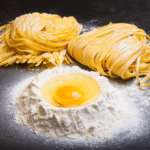
Homemade Pasta
Servings: 4
Print RecipeIngredients
- 200 g "00" soft wheat flour 1 ⅓ cups
- 200 g durum wheat flour (semolina flour) 1 ⅓ cups
- 4 eggs
Instructions
The Pasta Dough (by hand)
- Place the flours on a work surface and create a hole with your hands. For those who are making homamade pasta for the first time, use a bowl because the job will be easier. Split the eggs and put them in a bowl. Then pour the eggs into the hole.
- With the help of your fingers, mix the eggs with the flours, incorporating a little at a time, until everything is combined. Knead the pieces of dough together. At this point, if you are using the bowl, remove the dough and place it on the table.Now you have to knead and wor5k it with your hands for about 10 minutes. Pay attention: if the dough is too soft and sticky, add flour; if it is too hard and with too much flour yet, add water. This is the hardest work but it's necessary. If you don't knead the flours with the eggs very well, the dough will be soft when cooked and not al dente as it should be.
- After ten minutes, make a big ball and wrap it in a cling film. Let it rest at room temperature for 15-30 minutes. The cling film is useful not to dry out the dough and let it go crusty around the edges while rolling it.
The Pasta Dough (with stand mixer)
- Pour the flour into the bowl of your stand mixer and start mixing with the spiral dough hook at speed 1. Add the eggs, one at a time, and continue to mix for 5-6 minutes until the mixture is smooth, but not compact. Now increase the speed to 2 and knead for another 5-6 minutes, until you get a ball.
- Turn off the machine, take the ball and knead it by hand for 1 minute. Put it back in the bowl of the mixer and knead it again for 2 minutes at speed 1. Now take the ball and wrap it in cling film, then let it rest for at least 15-30 minutes.
Roll out the pasta dough with a pasta maker
- Dust your work surface with some flour, using the durum wheat flour, that's important. Take a lump of pasta dough the size of a tennis ball and press it out flat with the palms of your hands. Keep the rest of the dough wrapped in cling film to keep it soft.
- Roll the lump of pasta dough through the widest setting of your pasta machine or pasta roller attachment. Remember to dust the pasta dough with durum wheat flour if you feel it's becoming sticky.
- Fold the pasta dough in half and then again in half.
- Then (again) roll the lump of pasta dough through the widest setting of the pasta machine. Repeat the process for 3 or 4 times (roll-fold-roll). You have to work the dough til it's smoother.
Roll out the pasta dough by hand
- Take a piece of dough and with your hands, make a ball the size of a tennis ball. Flatten it with your hands to give it a disc shape. Then roll out the dough on the work surface, always well floured with the durum wheat flour, with the help of a rolling pin. Start always from the center, sliding it in all directions in order to obtain a pasta sheet of uniform thickness. Keep rolling out the dough until it reaches a thickness of about 1 millimeter.For a classic pasta such as tagliatelle, tagliolini and pappardelle, roll up the pasta sheet starting from the flap facing down, without pressing. Then, with a long and sharp knife, cut the pasta into strips of 1-2 millimeters for the tagliolini, about 1cm for tagliatelle and 1-3 cm for pappardelle.
Lasagna
- Now you can start to roll the dough through all the remaining settings of your pasta machine, from the widest to the narrowest. The second-last setting is ideal as a thickness for homemade pasta like tagliatelle, tagliolini, pappardelle and even lasagna (about 1 millimeter). if you're making a stuffed pasta like ravioli or tortellini, you'll need to roll it down slightly thinner. If the strip of fresh pasta is too long, divide it in half.
- So now you have long strips of fresh pasta that you can use for different types of pasta.For lasagna sheets, roll out the dough until you have a long strip of 1 millimeter thick. Then cut it into ⅔ rectangular pieces. Now the lasagna sheets are ready. Do not forget to dip them 1 minute in boiling salted water and let cool and dry on kitchen towels before using them for your lasagna recipe.
Tagliatelle / Fettuccine
- The difference between tagliatelle and fettuccine lies only in the width of the pasta strips, although there is not always agreement on the measures. Fettuccine must have a width smaller than tagliatelle. Fettuccine can vary from 3 to 5 mm while tagliatelle between 6 and 10 mm. The recipe and the method are exactly the same for both.Roll out the dough following the instructions above until it reaches a thickness of about 1 mm. Then pass the sheet of dough (which you have previously floured) through the blades of your pasta roller used to make tagliatelle/fettuccine.
Tagliolini
- Roll out the dough until it reaches a thickness of about 1 mm. As for taglitelle, every pasta maker machine has a useful tool for making taglioline. Therefore, flour the sheet of dough and pass it through the blades of your machine. Taglioline usually have a width ranging from 1 to 2 mm.
Pappardelle
- Pappardelle are the biggest long fresh pasta you can make at home. They have a width of more than 1 cm so you can make them by hand. So roll out the dough until it reaches a thickness of about 1 mm then roll it on itself and with a sharp knife, cut it into strips of dough, same width, if possible. With this method, you can even make tagliatelle and fettuccine. It always depends on the width of the pasta strips.
Notes
Summing up:
Taglioline (1-2 mm); Fettuccine (3-5 mm); Tagliatelle (6-10 mm); Pappardelle (1-3 cm)
STORAGE
In the Refrigerator
Let pasta dry on a special drying rack or make some nests with you hands and place them to dry on a tray. Either way, if you don't cook the pasta immediately, store for 1-2 days in the refrigerator (not more).
Freezing
You can even freeze homemade pasta in the various chosen formats. Arrange tyhem in nests and place them on a tray that you have previously covered with a little baking paper, with a distance of 1 inch between one nest and another.
Then place the tray in the freezer. Wait 1-2 hours for the pasta to freeze. Now take the nests, which will be very stiff, and place them in a freezer bag. Close it with a knot and place them in the freezer. You can keep fresh pasta in a freezer for about 1 month.
When you want to cook them, don't defrost, but put them STILL FROZEN in plenty of salted boiling water. Stir often and cook for about 5-6 minutes.
This method applies to all types of fresh egg pasta, such as pasta sheets for lasagna (prepare them and freeze them on top of each other separated by sheets of baking paper), tagliatelle, tagliolini, quadratini, farfalle, ravioli and all filled pasta.
VARIATIONS AND TIPS
Pasta without eggs
If you want to make homemade pasta without eggs, you must know that the method is similar to that of fresh egg pasta.
In the well of the flour fountain, add a pinch of salt and pour warm water. The amount of water must be about half the weight of the flour, that is 400 g (14 oz) of flour, 200 g (7 oz) of water. Instead of the "00" flour, use only durum wheat semolina, so you will get a pasta with more resistance to cooking.
With this type of dough, you can get many types of pasta shapes, (orecchiette, corzetti, cavatelli, bacatini, trofie), which, in general, have the characteristic of being thick and therefore should not be drained al dente.
The Flour
Some people prefer a finer pasta, so they must use a white flour (soft wheat flour). Others love a rustic tasted, which you can have by adding percentages of durum wheat flour to soft wheat flour (e.g.: 50% flour "00" + 50% durum wheat flour as in this recipe). Instead of "00" flour, you can use durum wheat flour (semola flour), which is richer in protein. This way, you can get a pasta dough with a top cooking seal.
The basic recipe of homemade pasta wants the "00" flour or durum wheat or mixed. For 400 g (14 oz) of flour, you need 4 eggs of a least 70 g (2.5 oz) each.
The Salt
According to the currents of thought of Emilia Romagna region (home of fresh homemade pasta), you should not add salt to the dough, but only to the boiling water. According to other, however, a pinch of salt would not hurt.
Homemade pasta made without eggs (flour and water) wants a pinch of salt and warm water to facilitate hydration of the starch.
With the dough without eggs, usually you get pasta like cavatelli, trofie, orecchiette, bucatini, fusilli, strozzapreti. For tagliatelle, tagliolini, lasagna and stuffed pasta in general, it's better using the traditional dough with eggs.
Nutrition
Calories: 425kcal | Carbohydrates: 75g | Protein: 17g | Fat: 5g | Saturated Fat: 2g | Polyunsaturated Fat: 1g | Monounsaturated Fat: 2g | Trans Fat: 0.02g | Cholesterol: 164mg | Sodium: 64mg | Potassium: 207mg | Fiber: 2g | Sugar: 0.3g | Vitamin A: 238IU | Calcium: 41mg | Iron: 5mg